
Im heutigen Artikel gibt es drei schnelle Möglichkeiten, um Statistiken zur Wortanzahl in Bezug auf Textfelder, Fußnoten und Endnoten in Ihrem Dokument abzurufen.
Es ist nicht schwer, die Gesamtzahl der Wörter in einem Dokument zu ermitteln. Wenn Sie jedoch die Anzahl der Wörter verschiedener Textarten ermitteln möchten, sind weitere Vorgänge erforderlich. Es folgen 3 Methoden. Lesen Sie weiter, um zu sehen, was Sie verwenden können. 
Methode 1: Zählen von Wörtern einschließlich Texten aus Textfeldern, Fußnoten und Endnoten
Standardmäßig zählt Word alle Wörter, die im Dokument angezeigt werden, einschließlich Texten in Textfeldern und Wörtern aus Fuß- und Endnoten.
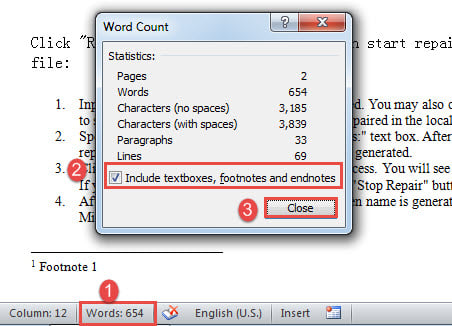
- Als Erstes sollten Sie in der Statusleiste auf „Wörter“ klicken, um das Feld „Wortanzahl“ zu öffnen.
- Dort sehen Sie alle Arten von Statistiken. Stellen Sie sicher, dass Sie das Kontrollkästchen "Textfelder, Fußnoten und Endnoten einschließen" aktiviert haben.
- Klicken Sie dann auf "Schließen".

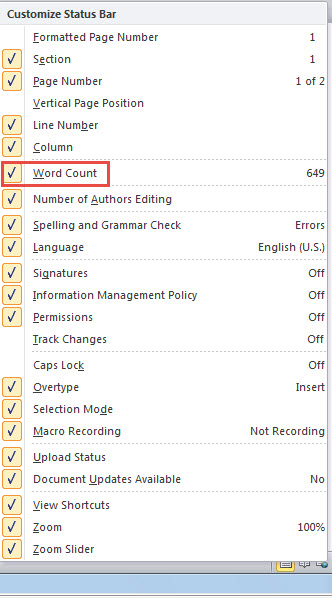
- Wenn Sie den Befehl "Wörter" in der Statusleiste nicht finden können, klicken Sie dort mit der rechten Maustaste.
- Überprüfen Sie als nächstes die "Wortzahl".

Methode 2: Ausschließen von Texten aus Textfeldern, Fußnoten und Endnoten aus der Wortanzahl
Dies steht im Gegensatz zu Methode 1. Sie müssen also nur das Kontrollkästchen "Textfelder, Fußnoten und Endnoten einschließen" deaktivieren.
Methode 3: Führen Sie das Wortmakro aus, um die Anzahl der Wörter von Textfeldern, Fußnoten und Endnoten zu trennen
- Lösen Sie zunächst das Kontrollkästchen "Wortanzahl" wie in Methode 1 beschrieben aus und stellen Sie sicher, dass das Optionsfeld aktiviert ist.
- Drücken Sie anschließend „Alt + F11“, um den VBA-Editor zu öffnen.
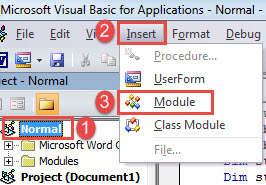
- Fügen Sie dann ein neues Modul in das Projekt „Normal“ ein, indem Sie zuerst auf „Normal“ klicken.
- Klicken Sie anschließend auf "Einfügen".
- Wählen Sie dann "Modul".

- Doppelklicken Sie auf das Modul, um den Codierungsbereich zu öffnen, und fügen Sie dort die folgenden Codes ein:
Sub SeparateCountNumberOfTextboxFootnoteEndnote()
  Dim lTextboxWords As Long
  Dim lTextboxChars As Long
  Dim lDocumntWords As Long
  Dim lDocumntChars As Long
  Dim objTextboxShape As Shape
  Dim objTemp As Dialog
  Dim bDone As Boolean
  Dim objRange As Range
  Dim lFootnoteWords As Long
  Dim lFootnoteChars As Long
  Dim lEndnoteWords As Long
  Dim lEndnoteChars As Long

  Application.ScreenUpdating = False

 Do
   bDone = True
   For Each objTextboxShape In ActiveDocument.Shapes
     If objTextboxShape.Type = msoGroup Then
       objTextboxShape.Ungroup
       bDone = False
     End If
   Next objTextboxShape
 Loop Until bDone

 '  Count the words and characters in the whole document.
 Selection.HomeKey Unit:=wdStory
 Set objTemp = Dialogs(wdDialogToolsWordCount)
   objTemp.Update
   objTemp.Execute
   lDocumntWords = objTemp.Words
   lDocumntChars = objTemp.Characters

 With ActiveDocument
 '  Count the words and characters in all textboxes.
   lTextboxWords = 0
   lTextboxChars = 0
   If ActiveDocument.Shapes.Count > 0 Then
     For Each objTextboxShape In .Shapes
       objTextboxShape.Select
       objTemp.Execute
       lTextboxWords = lTextboxWords + objTemp.Words
       lTextboxChars = lTextboxChars + objTemp.Characters
     Next objTextboxShape
   Else
     MsgBox ("There is no text box in this document")
   End If

   '  Count the words and characters in all footnotes.
   lFootnoteWords = 0
   lFootnoteChars = 0
   If ActiveDocument.Footnotes.Count > 0 Then
     For Each objRange In .StoryRanges
       If objRange.StoryType = wdFootnotesStory Then
         objRange.Select
         objTemp.Execute
         lFootnoteWords = lFootnoteWords + objTemp.Words
         lFootnoteChars = lFootnoteChars + objTemp.Characters
       End If
     Next objRange
   Else
     MsgBox ("There is no footnote in this document")
   End If

   '  Count the words and characters in all endnotes.
   lEndnoteWords = 0
   lEndnoteChars = 0
   If ActiveDocument.Endnotes.Count > 0 Then
     For Each objRange In .StoryRanges
       If objRange.StoryType = wdEndnotesStory Then
         objRange.Select
         objTemp.Execute
         lEndnoteWords = lEndnoteWords + objTemp.Words
         lEndnoteChars = lEndnoteChars + objTemp.Characters
       End If
     Next objRange
   Else
     MsgBox ("There is no Endnote in this document")
   End If
 End With

 Application.ScreenUpdating = True

 MsgBox (" In this document there are totally" & vbCr _
   & Str(lDocumntWords) & " word(s) and" & Str(lDocumntChars) & " characters" & vbCr & vbCr _
   & "Including:" & vbCr _
   & Str(ActiveDocument.Shapes.Count) & " textboxes contain(s)" & vbCr _
   & Str(lTextboxWords) & " word(s)," & Str(lTextboxChars) & " characters" & vbCr & vbCr _
   & Str(ActiveDocument.Footnotes.Count) & " footnotes contain(s)" & vbCr _
   & Str(lFootnoteWords) & " word(s)," & Str(lFootnoteChars) & " characters" & vbCr & vbCr _
   & Str(ActiveDocument.Endnotes.Count) & " Endnotes contain(s)" & vbCr _
   & Str(lEndnoteWords) & " word(s)," & Str(lEndnoteChars) & " characters")
End Sub
- Klicken Sie abschließend auf die Schaltfläche "Ausführen".

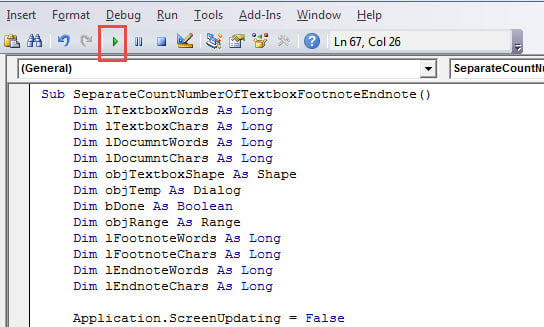
Wenn kein Textfeld, keine Fußnote oder Endnote vorhanden ist, erhalten Sie ein Meldungsfeld wie folgt: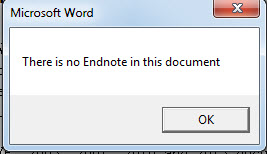
Klicken Sie einfach auf "OK", um fortzufahren. Dann sehen Sie ein weiteres Feld, in dem alle Details der Wortanzahl aufgeführt sind.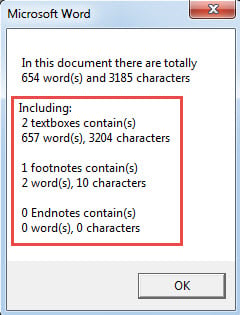
Holen Sie sich ein Wiederherstellungswerkzeug
Da Word plötzlich zusammenbrechen kann, ist es ratsam, ein fortschrittliches Reparaturprodukt zu erwerben, um die Reparaturarbeiten durchzuführen. Ein solches Werkzeug kann eine große Ersparnis sein korruptes Wort. Nehmen Sie sich daher Zeit, um so schnell wie möglich eine zu erhalten.
Einführung des Autors:
Vera Chen ist eine Datenrettungsexpertin in DataNumen, Inc., das weltweit führend bei Datenwiederherstellungstechnologien ist, einschließlich xls reparieren und pdf Reparatur von Softwareprodukten. Für weitere Informationen besuchen Sie www.datanumen.com €XNUMX