
În articolul de astăzi, există 3 moduri rapide de a obține statistici privind numărul de cuvinte legate de casetele de text, notele de subsol și notele de final din documentul dvs.
Nu este greu să obțineți numărul total de cuvinte dintr-un document. Dar dacă doriți să obțineți numărul de cuvinte ale diferitelor tipuri de texte, atunci vor fi necesare mai multe operații. Mai jos sunt 3 metode. Citiți mai departe pentru a vedea ce puteți folosi. 
Metoda 1: Numărați cuvintele, inclusiv textele din casetele de text, note de subsol și note de final
În mod implicit, Word numără toate cuvintele care apar pe document, inclusiv textele din casetele de text și cuvintele din notele de subsol și notele de final, de asemenea.
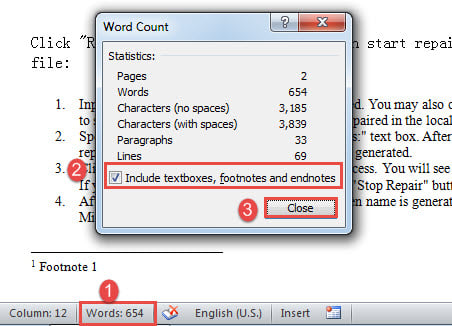
- În primul rând, accesați bara de stare și faceți clic pe „Cuvinte” pentru a deschide caseta „Număr de cuvinte”.
- Acolo vei vedea tot felul de statistici. Asigurați-vă că ați bifat caseta „Include casete de text, note de subsol și note de final”.
- Apoi faceți clic pe „Închidere”.

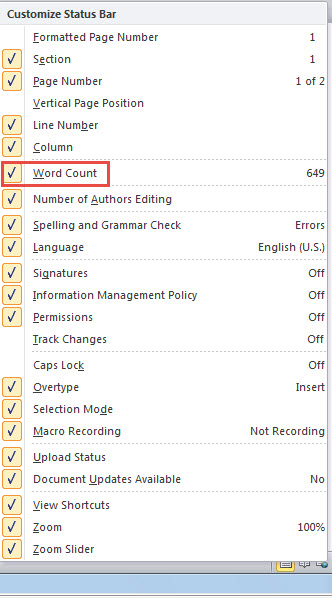
- Dacă nu puteți găsi comanda „Cuvinte” pe bara de stare, faceți clic dreapta pe acolo.
- Apoi verificați „Numărul de cuvinte”.

Metoda 2: Excludeți texte din casetele de text, notele de subsol și notele de final din numărul de cuvinte
Aceasta este opusă metodei 1. Deci trebuie doar să debifați caseta „Include casete de text, note de subsol și note de final”.
Metoda 3: Executați macrocomandă Word pentru a obține un număr separat de cuvinte din casetele de text, note de subsol și note de final
- În primul rând, declanșați caseta „Număr de cuvinte” folosind metoda din metoda 1 și asigurați-vă că caseta de opțiuni este bifată.
- Apoi apăsați „Alt+ F11” pentru a deschide editorul VBA.
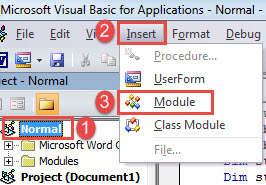
- Apoi inserați un nou modul în proiectul „Normal” făcând mai întâi clic pe „Normal”.
- Și faceți clic pe „Inserați” în continuare.
- Apoi alegeți „Modul”.

- Faceți dublu clic pe modul pentru a deschide zona de codare și lipiți acolo următoarele coduri:
Sub SeparateCountNumberOfTextboxFootnoteEndnote()
  Dim lTextboxWords As Long
  Dim lTextboxChars As Long
  Dim lDocumntWords As Long
  Dim lDocumntChars As Long
  Dim objTextboxShape As Shape
  Dim objTemp As Dialog
  Dim bDone As Boolean
  Dim objRange As Range
  Dim lFootnoteWords As Long
  Dim lFootnoteChars As Long
  Dim lEndnoteWords As Long
  Dim lEndnoteChars As Long

  Application.ScreenUpdating = False

 Do
   bDone = True
   For Each objTextboxShape In ActiveDocument.Shapes
     If objTextboxShape.Type = msoGroup Then
       objTextboxShape.Ungroup
       bDone = False
     End If
   Next objTextboxShape
 Loop Until bDone

 '  Count the words and characters in the whole document.
 Selection.HomeKey Unit:=wdStory
 Set objTemp = Dialogs(wdDialogToolsWordCount)
   objTemp.Update
   objTemp.Execute
   lDocumntWords = objTemp.Words
   lDocumntChars = objTemp.Characters

 With ActiveDocument
 '  Count the words and characters in all textboxes.
   lTextboxWords = 0
   lTextboxChars = 0
   If ActiveDocument.Shapes.Count > 0 Then
     For Each objTextboxShape In .Shapes
       objTextboxShape.Select
       objTemp.Execute
       lTextboxWords = lTextboxWords + objTemp.Words
       lTextboxChars = lTextboxChars + objTemp.Characters
     Next objTextboxShape
   Else
     MsgBox ("There is no text box in this document")
   End If

   '  Count the words and characters in all footnotes.
   lFootnoteWords = 0
   lFootnoteChars = 0
   If ActiveDocument.Footnotes.Count > 0 Then
     For Each objRange In .StoryRanges
       If objRange.StoryType = wdFootnotesStory Then
         objRange.Select
         objTemp.Execute
         lFootnoteWords = lFootnoteWords + objTemp.Words
         lFootnoteChars = lFootnoteChars + objTemp.Characters
       End If
     Next objRange
   Else
     MsgBox ("There is no footnote in this document")
   End If

   '  Count the words and characters in all endnotes.
   lEndnoteWords = 0
   lEndnoteChars = 0
   If ActiveDocument.Endnotes.Count > 0 Then
     For Each objRange In .StoryRanges
       If objRange.StoryType = wdEndnotesStory Then
         objRange.Select
         objTemp.Execute
         lEndnoteWords = lEndnoteWords + objTemp.Words
         lEndnoteChars = lEndnoteChars + objTemp.Characters
       End If
     Next objRange
   Else
     MsgBox ("There is no Endnote in this document")
   End If
 End With

 Application.ScreenUpdating = True

 MsgBox (" In this document there are totally" & vbCr _
   & Str(lDocumntWords) & " word(s) and" & Str(lDocumntChars) & " characters" & vbCr & vbCr _
   & "Including:" & vbCr _
   & Str(ActiveDocument.Shapes.Count) & " textboxes contain(s)" & vbCr _
   & Str(lTextboxWords) & " word(s)," & Str(lTextboxChars) & " characters" & vbCr & vbCr _
   & Str(ActiveDocument.Footnotes.Count) & " footnotes contain(s)" & vbCr _
   & Str(lFootnoteWords) & " word(s)," & Str(lFootnoteChars) & " characters" & vbCr & vbCr _
   & Str(ActiveDocument.Endnotes.Count) & " Endnotes contain(s)" & vbCr _
   & Str(lEndnoteWords) & " word(s)," & Str(lEndnoteChars) & " characters")
End Sub
- În cele din urmă, faceți clic pe butonul „Run”.

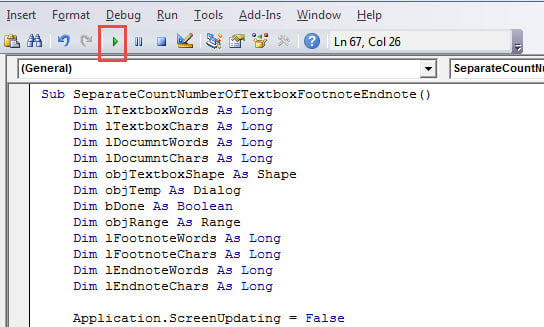
Dacă nu există casetă de text, notă de subsol sau notă de final, veți primi o casetă de mesaj ca aceasta: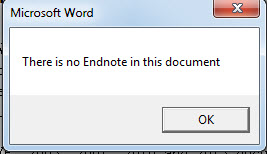
Doar faceți clic pe „OK” pentru a continua. Apoi veți vedea o altă casetă, care listează toate detaliile numărului de cuvinte.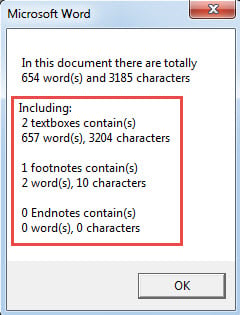
Obțineți un instrument de recuperare
Deoarece Word se poate prăbuși dintr-o dată, este recomandabil să obțineți un produs de reparații avansat pentru a face munca de reparare. Un astfel de instrument poate fi un mare economisitor pentru Cuvânt corupt. Prin urmare, profitați de timp pentru a obține unul cât mai curând posibil.
Introducerea autorului:
Vera Chen este expertă în recuperarea datelor DataNumen, Inc., care este lider mondial în tehnologiile de recuperare a datelor, inclusiv reparați xls și pdf repararea produselor software. Pentru mai multe informații vizitați www.datanumen.com